(Correction on 01/13/2020): Original version of this post mentioned that
“GNU grep ships as a standalone executable”.
lobste.rs user
aufziehvogel pointed out that GNU
grep is actually a set of dynamically linked libraries, which both he and I
verified through ldd:
$ lsb_release -a
No LSB modules are available.
Distributor ID: Ubuntu
Description:    Ubuntu 19.10
Release:        19.10
Codename:       eoan
$ ldd /usr/bin/grep
        linux-vdso.so.1 (0x00007fffb6bfe000)
        libpcre.so.3 => /lib/x86_64-linux-gnu/libpcre.so.3 (0x00007f7e078e8000)
        libdl.so.2 => /lib/x86_64-linux-gnu/libdl.so.2 (0x00007f7e078e2000)
        libc.so.6 => /lib/x86_64-linux-gnu/libc.so.6 (0x00007f7e076f1000)
        libpthread.so.0 => /lib/x86_64-linux-gnu/libpthread.so.0 (0x00007f7e076ce000)
        /lib64/ld-linux-x86-64.so.2 (0x00007f7e079a5000)
Changed to say “a set of dynamically linked libraries, with a handful of
references in /usr/bin as {grep, egrep, fgrep, rgrep}”.
(Correction on 01/13/2020): Original version of this post mentioned “GNU
grep”. lobste.rs user
zge pointed out that while grep was released
1974, GNU grep is much newer, being released during 1992, according to the
authors file on
gnu.org. Changed 2
instances of “GNU grep” to “grep”.
Society grows great when old men plant trees whose shade they know they shall never sit in.
Greek Proverb
You know what’s crazy? grep was released
45 years ago. 45 years. To put that into perspective, I Googled (or rather,
used DuckDuckGo) “headlines 1974”, and apparently people were talking about,
among other things, Richard Nixon’s resignation, Patty Hearst’s kidnapping, and
Frank Sinatra’s performance at Madison Square Garden.
I hate being the guy to say “the 90s started 30 years ago”, so let’s reframe this discussion to avoid talking about how old we are. I’ve found that I love old things, particularly old tech.
My family’s first new car (in fact, probably my lineage’s first new car) is a 2000 Honda Accord, that we still drive 20 years later. When I was growing up, my dad never failed to point out the new cars and say how hard it was to change the timing belt, or change the oil, or realign the tires, or some other maintenance nightmare a random coworker might have shared in passing, all of which he does himself. I remember during the Great Recession, when Pontiac went out of business, a whole bunch of new Pontiacs were driving around because the dealerships had fire sales. If I think about it, I don’t see too many Pontiacs these days, and those cars were a decade newer than my dad’s. I still see the occasional 2000 Honda Accord.
If I had to quantify this feeling, I might say it’s a longing for freedom. That which you choose, you own, you maintain, and you defend lends you your dignity and your identity. There’s this great article about farmers purchasing 40 year old John Deere tractors because newer tractors require a subscription service to maintain them, and because the service could have a 2 week long maintenance backlog, your crops could go bad if you didn’t harvest them at the right time. I’m sure the economics makes purchasing these old tractors common sense. Lower prices and lower operational costs mean higher profit, after all. But I’m sure the feeling of fear and humiliation of relying on something you can’t fix so you can feed your family engenders a strong emotional attachment and appreciation for independence. At least, that’s how I would feel, and I don’t think I’m alone.
When something is old, when it stands the test of time, it’s a testament to the care and love and thought a craftsman put into it. It’s a legacy, like a tree you plant for your kids. It’s progress too! It feels us feel proud to be human, more than just apes constantly reinventing the wheel. Like maybe if we can stack one stone on another without the pile falling over, we could go places. I think those are all good reasons to get out of bed in the morning.
So now that I’ve explained why I’m so invested in makings things that last, how exactly do we make tech that ages well?
To me, tech that ages well:
-
stays simple in important ways:
grepships as a set of dynamically linked libraries, with a handful of references in/usr/binas{grep, egrep, fgrep, rgrep}. Among other benefits, this may make it easier to instrument, to deploy and to permission. It also has an tightly scoped interface contract, with UNIX-based stdin/stdout/stderr, which means any programming language with shell compatibility can access it. -
gets better with changing requirements: Antifragile systems become stronger when faced with adversity. I love the concept of antifragility as an improvement over mere resiliency, and I’m looking forward to adding it to my common vernacular.
The humble barcode, first used in 1974 to scan a pack of chewing gum, takes up minimal packaging surface area, can be printed / faxed / scanned without losing fidelity, and remains tolerant to manufacturing defects using error correction codes, suboptimal scanning orientations using odd/even parity, and technology changes like OSes or encodings by defining your own encoding associativity.
This is all already pretty great, but the nice part about starting with a sparse encoding is that you can compress it. For smaller packages, and given tighter manufacturing tolerance guarantees, you can take a UPC-A barcode and physically shrink it into a UPC-E barcode by removing certain digits:
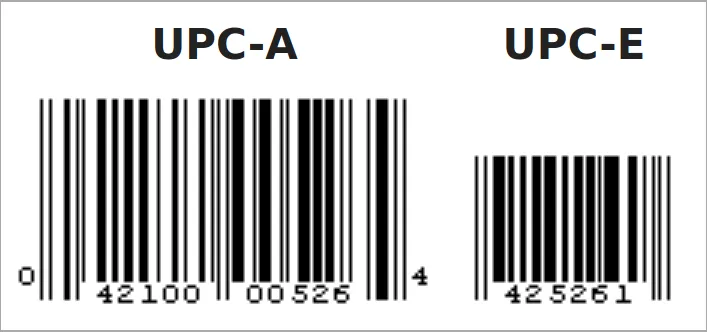
These are the same barcode, and yet one has maybe half the surface area of the other one. I can see how this can be helpful. You might also notice that the images aren’t scaled properly and suffer from significant artifacting, but that if you were to scan them, they’d probably still generate the proper product code. You could say this is a strict improvement, as the tradeoff between UPC-A and UPC-E is the number of possible product codes vs. space, and not say fault tolerance vs. space, and there are ways to work around limited product codes.
-
Fill a required niche better than anything else: I might get burned for this, but I’d say JavaScript isn’t at all as bad as some might say it is. We all like to poke fun at it, mostly because of its properties or lack thereof, but then we consider the alternatives for client-side applications. Adobe Flash? Microsoft Silverlight? Java applets? WebAssembly might be the only native alternative to JavaScript for rich content these days, and even then it’s impractical for most basic JS tasks, which may comprise the vast majority of the open Internet.
For something to age well, people have to need it. Only the code that ships matters, and without people needing it, nobody cares about what you’ve shipped. There’s two positives from this. When you’re first starting off, you enjoy a great deal of flexibility in implementation, and when you’re big, you can dump loads of money into making something “bad” usable. JavaScript happens to satisfy a multi-billion dollar “niche”. So I reckon we’ll see ES60 or something ridiculous 50 years from now.
You know, after writing this, maybe I should have referred to the Intel 8086 and the x86 ISA as an example of something that’s sticky. Oh well.
I may or may not be working on some personal projects this year that I intend on using for myself. One thing I know I can’t do for my personal projects is constantly dedicate time to working on it after I’ve “shipped”. I want to build something once, and ideally use it for the rest of my life (or maybe 20-50 years to start off) without having to worry about having to update something or other or risk losing something important down the line. So thinking about what properties makes software age well is helpful for me in terms of deciding what fundamental technologies (e.g. SQL or REST) I want to incorporate into a system design, and perhaps as equally important, what things I’m willing to trade away.